
References
Completed projects

Implementation of a constructed wetland wastewater treatment plant for 150 people - Museum in Svätý Anton
This project involves the construction of a constructed wetland wastewater treatment plant serving the museum in Sv. Anton. The manor house was completed in 1750 and its history is closely linked to the Koháry and Coburg families; it is a national cultural monument. The investor's brief was clear: to build a wastewater treatment plant that is functional, requires no maintenance, requires no electricity or spare parts, and blends seamlessly into the environment. Therefore, the only and most suitable solution for the museum was a maintenance-free constructed wetland wastewater treatment plant—Ekočistička®—and an artificial evaporative wetland. The constructed wetland wastewater treatment plant not only serves a functional purpose, as it treats wastewater water for 50,000 annual visitors and 25 permanent staff, but it also brings aesthetic value and fosters biodiversity. The constructed wetland works using gravel, sand, and wetland plants, in whose roots live beneficial bacteria that break down bacteria in the wastewater water. Contaminated wastewater water enters two vertical filters planted with approx. 950 plants, which, in combination with the filter media, purify the wastewater water up to 99%. The treated wastewater water is collected in an artificial wetland. This entire system significantly supports the biodiversity of the landscape. The treatment plant hosts a variety of insects and bees, and the wetland is home to birds, such as ducks. Last but not least, water evaporates into the environment instead of running off into streams and seas, thereby contributing to cooling the landscape and making the environment more pleasant.

🌱 Constructed wetland wastewater treatment plant for the ForRest Glamping resort below Sitno, Počúvadlo
📍BANSKÁ BYSTRICA REGION - The ECOair treatment plant type is a horizontal filter combined with filter aeration via a blower.📊 Type: ECOair 50 - aerated constructed wetland filter 40 m²🔧 Utilization type: 50 PE📍 Location: GPS 48.403201, 18.857374The treatment plant utilizes patented aerated wetland bed technology. Air distribution manifolds connected to 2 blowers are installed at the bottom of the bed, periodically delivering oxygen and supporting the growth of aerobic bacteria on the gravel. These ensure oxygenation of the treated wastewater, enhancing the overall efficiency of the system. The aerated wetland filter system also includes a control unit responsible for smooth and trouble-free plant operation. In aerated constructed wetlands, extra oxygen is supplied to the root bed via FBA® technology (forced bed aeration), which can boost treatment efficiency by up to tenfold and decrease footprint requirements by 4–6 times. Aeration ensures a higher, more consistent level of purification and flexibility in handling variable organic loads. The ECOair filter bed is filled with media providing a substrate for bacteria, which thrive on it and proliferate by actively removing contaminants from the wastewater. The bacterial activity in their natural habitat is reinforced and multiplied by the oxygen delivered to the filter bed. High-grade waterproofing at the bottom of the bed prevents untreated wastewater from leaching into groundwater. The relatively long retention time of the wastewater in the filter bed results in negligible sludge production in the filter system, as sludge serves as food for bacteria. The combination of aerobic and anaerobic processes creates diverse bacterial populations specializing in breaking down various types of contaminants. Consequently, the bacteria can eliminate even highly persistent substances, such as pharmaceuticals and drugs. Compared to conventional activated sludge systems, electrical power consumption with the ECOair system is substantially lower, as it requires far less aeration. The facility connected to the plant exhibits highly fluctuating load patterns – fully booked on weekends, while weekday occupancy drops to under 10%. Despite this, the treatment plant achieves outstanding results in degrading contaminants from wastewater. 📝 Example of wastewater analysis results from the treatment plant:02/2020 - BOD5: 2.5 mg/l; TSS: 3.0 mg/l06/2020: BOD5: 1.2 mg/l; TSS: 8.4 mg/l

🌱 Constructed wetland wastewater treatment plant for the Richňava recreation area, municipality of Štiavnické Bane
📍BANSKÁ BYSTRICA REGION - Within this project, the connection of existing recreational facilities to a newly built constructed wetland wastewater treatment plant (WWTP) was executed. 📊 Type: Horizontal filter 40 m² + vertical filter 40 m²; WWTP operates without electricity🔧 Utilization type: intermittent - 33 residents📍 Location: GPS 48.429655, 18.842743The newly constructed sewer line runs from the Penzión Richňava facility to the pipe outlet into an infiltration facility. The existing sanitary sewer line was shared by all affected buildings and previously drained into an existing wastewater treatment plant owned and managed by Comenius University. According to the design specifications, the shared sanitary sewer was interrupted after the last connected facility, which is Penzión Richňava. From there, wastewater first flows into sedimentation tanks with a total volume of 18 m³ into a horizontal filter. Following initial pre-treatment, the water enters a storage chamber equipped with an EKOPULZ pulse dosing unit and subsequently onto a vertical filter. Due to the absence of a nearby watercourse, infiltration into the ground was the only viable solution. The treated wastewater currently irrigates an existing mature oak grove even during periods of extreme drought.The treatment plant is in continuous operation, and samples taken at the plant outlet demonstrate proper system performance throughout both summer and winter months. Over two years of plant maintenance, the sedimentation tank was desludged, and the plants were mowed before winter to ensure that new shoots emerge in spring to aesthetically complement the surroundings of Penzión Richňava. 📝 Example of wastewater analysis results from the treatment plant:12/2018 - BOD5: 2.7 mg/l; TSS: 5.4 mg/l02/2019: BOD5: 12 mg/l; TSS: 2 mg/l05/2019: BOD5: 3.2 mg/l; TSS: 4.6 mg/l08/2019: BOD5: 4 mg/l; 6.4 mg/l

💦 Water retention measures in the village of Ľubeľa
📍ŽILINA REGION - The village of Ľubeľa has taken effective steps in water retention measures. The parking lot gained new functionality with Ecoraster permeable paving, eliminating puddles entirely. At the same time, a rain garden was created alongside it, enhancing local biodiversity. They did not forget the soccer field either, which is irrigated using rainwater collected efficiently in an underground storage tank.“These measures are an example of how ecology can be approached responsibly and practically. They bring savings, support nature, and make the village a more pleasant place to live. Ľubeľa has demonstrated that when things are done with quality and thoughtful planning, a village can serve as a role model for the surrounding area.” Ing. Erik Gemzický, PhD., MBA, Mayor of the Village of Ľubeľa. 📊 Here is basic information about the construction in numbers:🏠 1,092 m² of roofs were connected to the rainwater harvesting system – 580 m² from the municipal office roof and 512 m² from the TJ Partizán Ľubeľa sports facility.🌧️ According to design calculations, the engineered system can retain up to 1,568.88 m³ of rainwater annually, representing an incredible 1,568,880 liters of water! That is almost 79 full 20,000-liter storage tanks.🧱 We constructed 787.2 m² of permeable paving, through which water can naturally infiltrate into the subsoil instead of rapidly draining into the municipal sewer.🌿 45 m² of rain gardens and 26.4 m² of green infiltration strip were created.🌱 We planted a total of 526 plants – 360 perennials in the rain gardens and an additional 166 perennials and shrubs in the infiltration strip.💦 We also installed a 20,000-liter storage tank, allowing captured rainwater to be used for watering greenery and irrigating the soccer field.🚗 The project includes the construction of 4 parking spots designated for persons with disabilities. This is what exemplary and practical adaptation to climate change looks like – less water in the sewer, more water in the soil, more greenery, and a more pleasant microclimate for the community. 🌍💚

🌱 Conversion of an old WWTP into a constructed wetland with a capacity of 300 liters per day
📍PREŠOV REGION - In this project, we connected the constructed wetland to the original wastewater treatment plant, which had been demanding for the owner to operate and regularly maintain. Inside the existing treatment plant, we installed a sedimentation tank – a septic tank, where coarse debris is trapped and settles. The pre-treated water then flows by gravity through a diverter into the ECOPULZ dosing chamber. ECOPULZ is a pulse water doser that operates entirely without electrical power. It delivers water in regular pulses onto a vertical filter, ensuring its even distribution across the entire surface and regular oxygenation of the filter. The water subsequently trickles vertically through layers of gravel and sand, where its natural biological purification takes place. The entire system works gravitationally, without electricity and without mechanical parts, significantly simplifying its operation and reducing maintenance costs.📊 Here is basic information about the construction in numbers:💧 System capacity: 300 liters of water per day⚡️ Electricity consumption: 0 kWh⚙️ Mechanical parts: 0 🪨 Filter media used: 10 tons📅 Implementation time: 3 days👷 Work team: 3 people⌚️ Work and travel: 36 hours🚜 Machinery used: 2 machines 🚗Dumper operation: 12 hours♻️Utilization of the original WWTP: installation of a sedimentation tank – septic tankThe implementation was challenging mainly due to limited space and difficult access. All 10 tons of filter media had to be gradually transported using a dumper and then placed directly into the filter. Even an old and operationally demanding treatment plant can be transformed, with proper modifications, into a simpler, more economical, and more natural wastewater treatment system. Key characteristics:✅ utilization of the original treatment plant✅ diverter and ECOPULZ pulse doser✅ completely zero electricity✅ no mechanical parts✅ simple and low-maintenance operation✅ natural biological treatment✅ solution suitable even for spatially constrained conditions

🌱 Constructed Wetland Wastewater Treatment Plant for Ecocentre Holíč
📍TRNAVA REGION - For the Ecocentre in Holíč, we implemented a complete multi-stage wastewater treatment system combining the natural processes of a constructed wetland with modern ECOPULZ, EKOVER, and ECOAIR technologies.💧 How does the system work?Wastewater is first fed into a multi-chamber sedimentation tank where suspended solids are trapped and primary pre-treatment takes place. Pre-treated water then flows by gravity into the first dosing chamber equipped with an ECOPULZ pulse doser. It ensures regular and even dosing of water onto the EKOVER vertical reed bed filter with an area of 16 m². The first filter handles the heaviest load and provides intensive pre-treatment. Water is distributed through perforated piping laid beneath the surface of the filter and subsequently flows through individual aggregate layers. From the vertical filter, water continues into the second dosing chamber, also equipped with the ECOPULZ system, from where it is evenly fed into the main ECOAIR horizontal reed bed filter with an area of 80 m². Water gradually flows through the entire body of the filter, where purification is provided by microorganisms forming a natural biofilm on the surface of the filter aggregate. The main filter is complemented by the modern ECOAIR aeration system, which actively introduces air into the root zone at preset time intervals. Better oxygenation creates more favorable conditions for bacteria and increases the removal efficiency of pollutants. The system also includes a recirculation chamber with a submersible pump, allowing part of the water to be returned for re-treatment. At the end of the process, treated water flows into a series of three polishing and evaporation ponds, where it naturally returns to the surrounding environment through evaporation and transpiration of the planted vegetation.📊 Here is basic information about the construction in numbers:💧 Annual wastewater production: 264 m³💦 Sedimentation tank: 1 pc ♻️ ECOPULZ pulse dosers: 2 pcs🌿EKOVER vertical filter: 16 m²🌱 ECOAIR horizontal filter: 80 m²💦 Polishing ponds: 3 × 12 m²🌱 Planted vegetation: 2,150 pcs🧱 Aggregates used: more than 200 tons🛡️ Fatrafol 818 welded waterproofing membrane: 310 m²🟦Protective and underlay geotextile: 700 m²🔨 Sewer piping: 200 meters👷 Installation team: 5 workers⏱️ Working hours: 200 hours🚜Machinery used: 3 machinesThe waterproofing construction of the reed bed filters was carried out by our certified personnel using welded Fatrafol 818 membrane. The membrane is protected on both sides with geotextile and ensures complete separation of the system from the surrounding subsoil. Each filter is also equipped with a separate chamber that allows system inspection and sampling of treated water. Main features:✅ multi-stage wastewater treatment✅ combination of vertical and horizontal filters✅ two ECOPULZ pulse dosers✅ ECOAIR active aeration✅ water recirculation option✅ natural post-treatment in ponds✅ more than 2,000 planted plants✅ water retention directly in the environment

🌿 ECOVER – Constructed Wetland WWTP Without Electricity for 4 Persons
📍TRENČÍN REGION - An ecological system with gravity connection to a septic tank that operates completely without electricity. Wastewater first flows by gravity into the septic tank, where coarse impurities are trapped and settled. It then passes through a flow diverter into the ECOPULZ dosing chamber. ECOPULZ is a pulse water doser operating without electricity. It delivers water to the vertical filter in regular doses and time intervals. This ensures an even distribution of water across the entire surface of the filter and its regular oxygenation. The water then flows vertically through layers of gravel and sand, where natural biological treatment takes place. After treatment, it drains by gravity into an infiltration facility, keeping it retained directly in the environment. Advantages:✅ zero electricity✅ pump-free✅ low operating costs✅ natural biological treatment✅ water retention in the landscape✅ simple and reliable operation 📊 Here is basic information about the construction in numbers:👨👩👧👦 Capacity: 4 persons💧 Volume of treated water: 600 liters per day⚡ Electricity consumption: 0 kWh🪨 Filter material: 18 tons🌱 Planted vegetation: 50 pcs👷 Working team: 3 people⏱️ Working hours: 14 hours🚜 Machinery: 1× excavator🚚 Distance traveled: 500 km
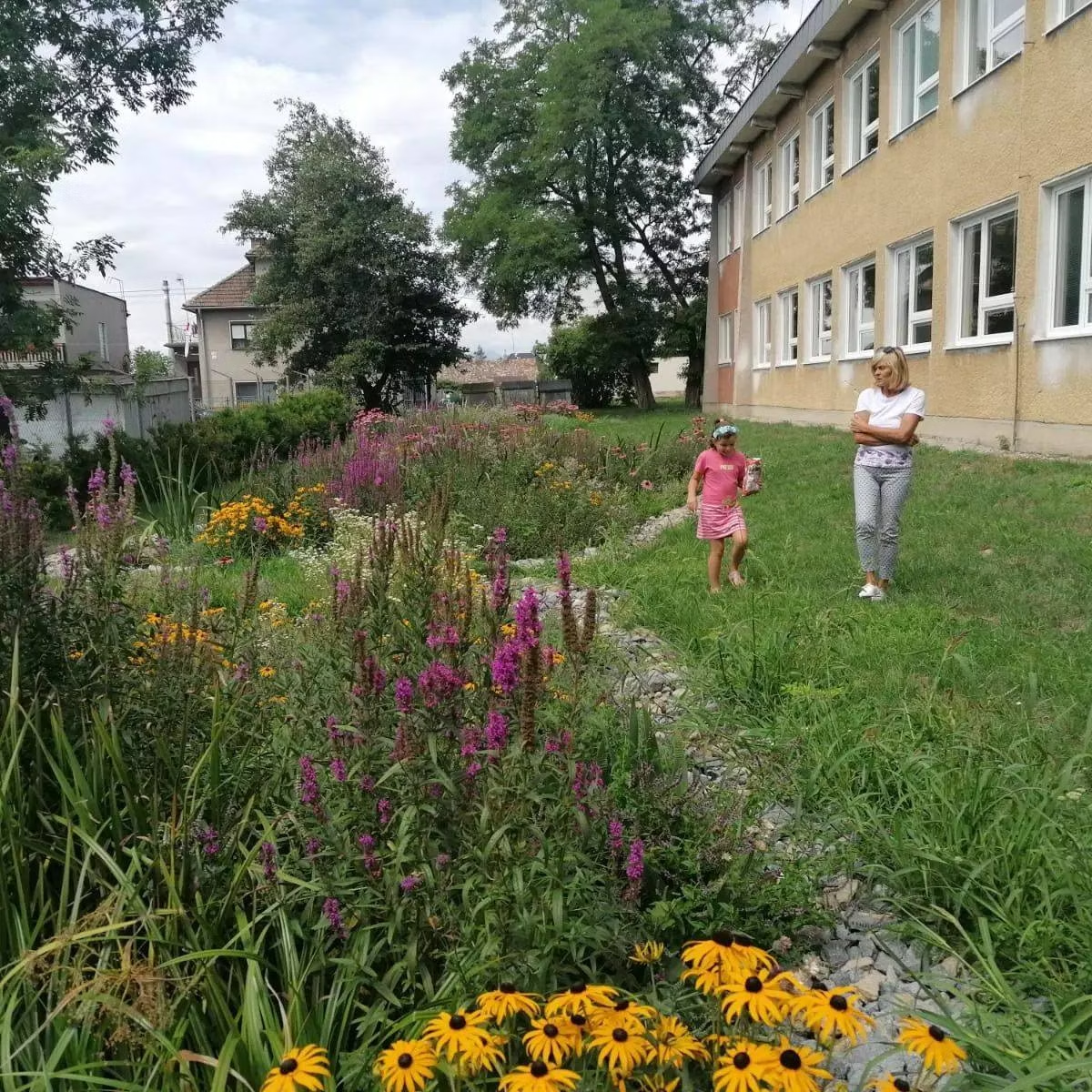
💦 Rain gardens for the town of Liptovský Mikuláš
📍ŽILINA REGION - Water retention measures in practice - rain gardens for the town of Liptovský Mikuláš save over €10,000 per year on stormwater fees. We are the authors of a unique project for the town of Liptovský Mikuláš. This project involves rain gardens designed to capture rainwater. Our priority was to retain rainwater right where it falls, support local biodiversity, and disconnect properties from the storm sewer system, thereby eliminating rainwater fees. We accomplished all this at secondary schools and kindergartens.A total of 19 new rain gardens were created. This is a functional, economical, beneficial, and aesthetically very attractive measure that serves to infiltrate rainwater from roofs into the ground. Water no longer drains unnecessarily into the sewer system, and schools do not pay for it as they did before. The water infiltrates into the rain garden, into the subsoil, replenishing groundwater; it also evaporates from the surface, having a positive impact on the local microclimate. It thus returns water back into the small water cycles. We also kept biodiversity in mind, and over 7,000 plants of various species—from wetland to drought-tolerant—were planted in the gardens. We retained 5,408,000 liters of water in the environment from 2,640 m2 of roofs, planted over 7,000 plants, and built over 700 m2 of rain gardens.

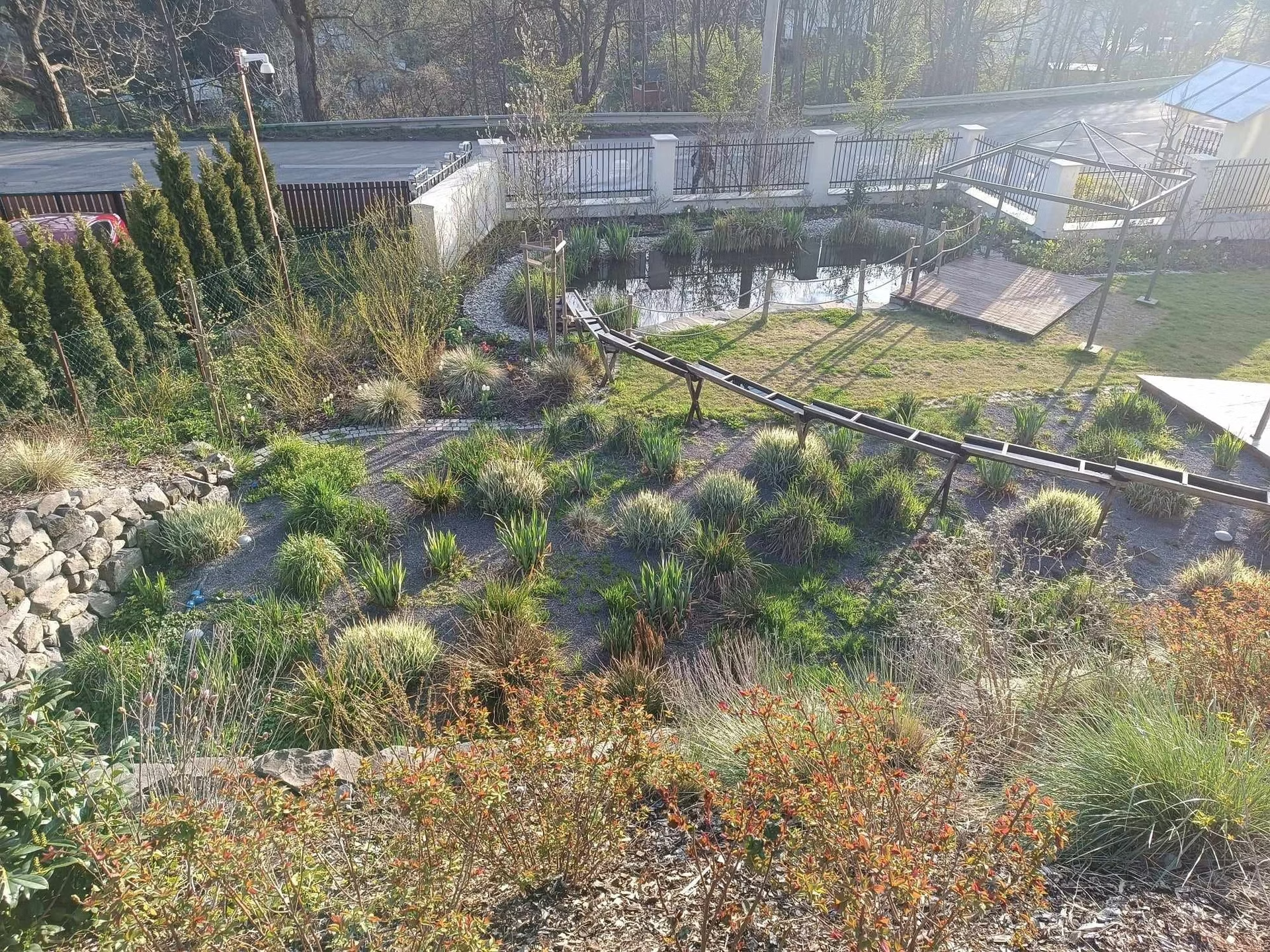


ECOBAG – Vegetated Green Retaining Wall
ECOBAG GREEN RETAINING WALL ECOBAG is a green retaining wall. This technology is used for building retaining walls with a long-standing tradition. It is a simple system that allows you to build a natural, green, and great-looking retaining wall yourself. And all this for a fraction of the time and money. Once filled with soil, or a mixture of soil and sand or gravel, simply lay the bag according to the instructions and repeat the process. The ECObag system is fast and simple, while offering a huge variety of applications, whether around the house or on a construction site. You need approximately 12 bags per 1m2 of wall. Best price on the market
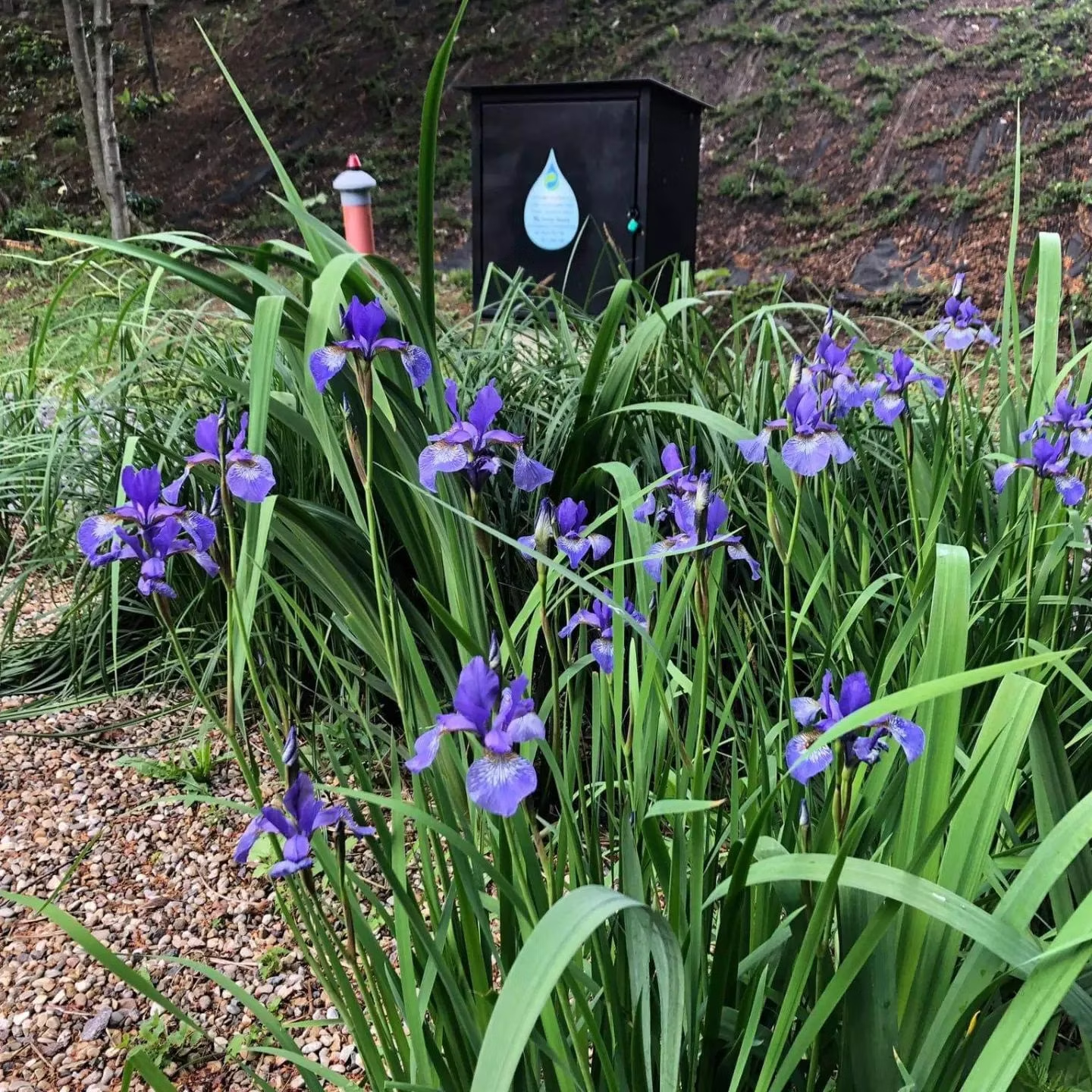


🌱 Constructed Wetland Wastewater Treatment Plant for the Re-socialisation Facility Komunita Ľudovítov - Poloma, Krupina
📍BANSKÁ BYSTRICA REGION - The ECOair treatment plant type is a horizontal filter combined with filter aeration using a blower.📊 Type: ECOair 50 - aerated reed bed filter 40 m2🔧 Capacity / Type of use: 50 PE📍 Location: GPS 48.416290, 19.105566. The treatment plant utilizes patented aerated reed bed technology. Air distribution piping connected to 2 blowers is installed at the bottom of the bed, supplying oxygen at regular intervals and promoting the growth of aerobic bacteria on the gravel. These ensure the oxygenation of the treated wastewater, thereby increasing the overall efficiency of the system. The aerated reed bed system also includes a control unit that ensures the smooth and trouble-free operation of the treatment plant. In aerated reed bed treatment plants, extra oxygen is supplied to the root bed via FBA® technology (Forced Bed Aeration), which can increase treatment efficiency up to tenfold and reduce footprint requirements by 4–6 times. Aeration ensures a higher, more consistent level of treatment and flexibility in handling variable organic loads. The filter bed of the ECOair system is filled with filter medium that forms a substrate for bacteria. They grow on it and thrive by actively removing contaminants from the wastewater. The activity of the bacteria in their natural environment is enhanced and multiplied by delivering oxygen into the filter bed. High-quality waterproofing at the bottom of the bed prevents untreated wastewater from leaking into groundwater. The relatively long retention time of wastewater in the filter bed results in negligible sludge production within the filtration system, as sludge serves as food for the bacteria. The combination of aerobic and anaerobic processes creates a great diversity of bacteria throughout the system, specializing in decomposing various types of pollution. Thanks to this, bacteria can remove even very hard-to-degrade substances, such as pharmaceuticals and drugs. Compared to conventional activated sludge treatment plants, the electricity consumption of the ECOair system is substantially lower, as it requires much less aeration. As a rule, a single inspection visit is sufficient for system operation, which is very simple and consists of a visual inspection of the system and regular desludging of the sedimentation tank. 📝 Example of wastewater analysis results from the treatment plant:04/2020 - BOD5: 1.8 mg/l; TSS: 6.8 mg/l06/2020: BOD5: 2.3 mg/l; TSS: 4 mg/l